Vibration levels tell you something is wrong. Shaft orbits tell you what is wrong. If you are not looking at orbits, you are missing half the story.
We’ve all seen it: a washing machine that, during spin cycle, starts shaking… then moving… and suddenly it’s walking across the floor.
What’s going on?
Unbalance. The load shifts to one side. That concentrated mass forces the drum to move in a circular path as it spins: orbiting. And when that orbit gets big enough… the whole machine moves.
That’s a 70 kg washing machine. Annoying, but manageable. Now scale it to turbomachinery:
- A 2-ton compressor rotor at 15,000 RPM
- A 160 MW gas turbine driving an entire plant
Now “excessive vibration” isn’t just annoying. It has very real consequences:
🔴 Bearing damage
🔴 Fatigue in shafts and components
🔴 Coupling and alignment degradation
🔴 Foundation and structural damage
How do you catch this before it becomes a failure?
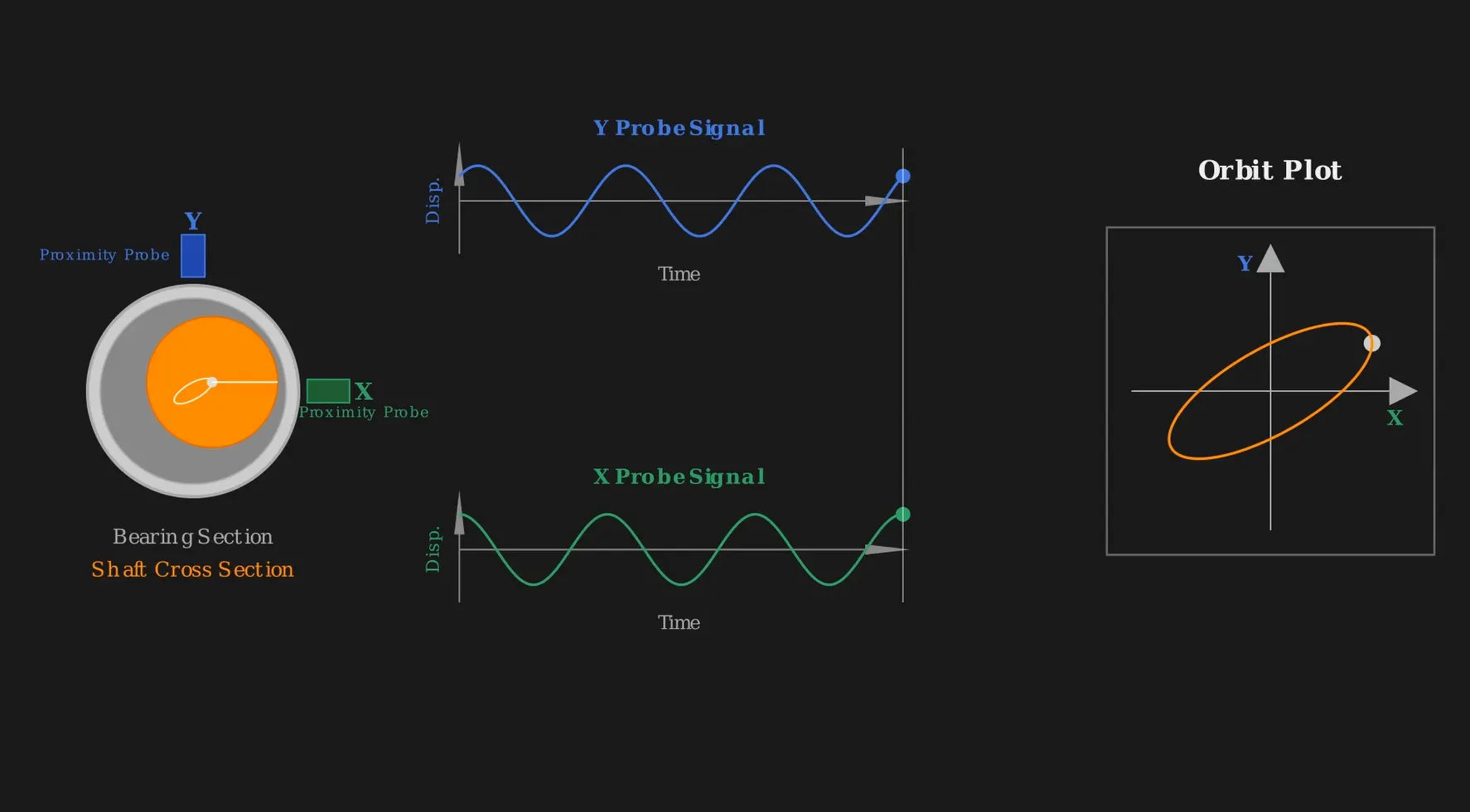
Using proximity probes: non-contact sensors that measure shaft position. Two probes are mounted 90° apart on the bearing housing:
- Probe X → horizontal movement (left–right)
- Probe Y → vertical movement (up–down)
Each probe outputs a voltage proportional to the shaft distance, continuously tracking its position. This gives you two signals: X(t) and Y(t). Individually, they’re just sine waves over time.
But here’s the key: plot X against Y.
- Time disappears
- Motion becomes geometry
What emerges is the shaft orbit: the real 2D path that the shaft center traces as it rotates. As if you were looking straight down at it.
The shape is the diagnosis
| Shape | Meaning |
|---|---|
| Circular | Unbalance — mass concentrated on one side of the rotor |
| Elliptical | Angular misalignment or asymmetric bearing stiffness |
| Internal loops | Oil whirl — hydrodynamic bearing instability |
| Truncated | Rub risk — rotor approaching clearance limit |
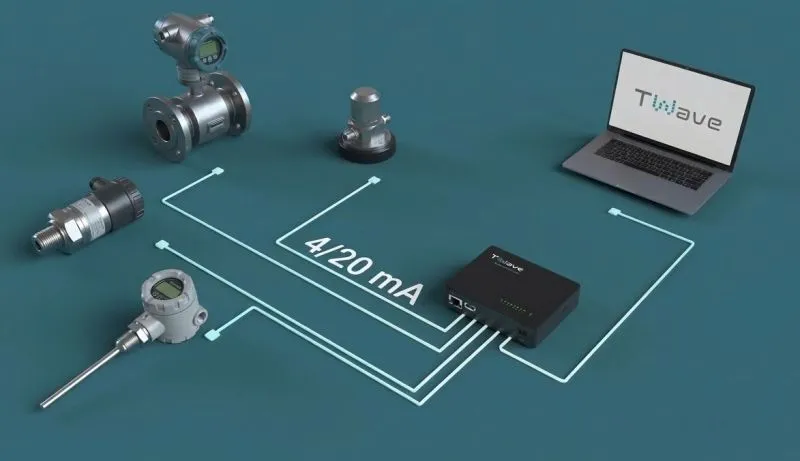
Vibration levels tell you something is wrong. The TWave T8 turns orbit data into clear insight on what is wrong.
If you’re not looking at shaft orbits… you’re missing half the story.
Each diagnostic tool answers different questions. Coming next: Bode plots, spectral cascades, shaft centerline, and real case studies.